Havana’s missing millions
While the world argues about sanctions, socialism and geopolitics, the Cuban people themselves are quietly disappearing

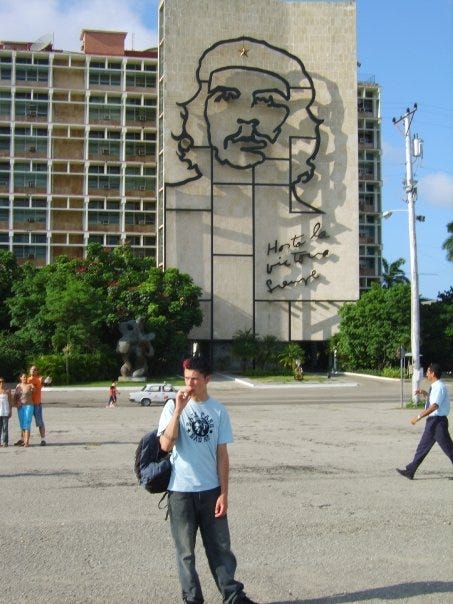
I have been thinking a lot about Cuba lately. I spent time on the island in the late 2000s - probably around a year of my life in total. I wrote my journalism dissertation about the country. I was present in person at one of the last speeches Fidel Castro gave as the country’s supreme leader (a predictably long-winded affair that began at around six o’clock in the morning to avoid the July heat). I made many friends and acquaintances along the way.
Most of the people I knew back then have since left the country, or at least the younger ones have. The last time I visited Cuba was in 2019. Since then things have deteriorated sharply. First the pandemic cut off the country’s main source of hard currency. Then Donald Trump returned to office and tightened economic sanctions. His administration recently arrested Cuba’s main benefactor in Venezuela and threatened to levy tariffs on any country that sold oil to Cuba.
I’ve tried to make sense of where the country is heading in a recent article for Foreign Policy, which argues that Cuba is not on the brink of collapse so much as entering a long, managed decline. You can read it here.
Extreme hardship is now widespread across the island. Shortages are rife and blackouts prolonged. Last week, the Cuban government warned that jet fuel would not be available at the country’s international airports from Feb 10 to Mar 11, 2026. Foreign embassies and companies are reportedly drawing up emergency evacuation and contingency plans. Several countries, including the UK, Canada and Ireland, have told their citizens to avoid non-essential travel to Cuba.
Having spent time in Cuba (and not in one of the plush resorts designed for tourists), you may understand why I have little patience for a certain type of western revolutionary who extols the virtues of the country while overlooking the abuses. The healthcare. The education. The war against apartheid South Africa in Angola. Trust me, I’ve heard the entire inventory. I also understand (or at least I think I do) why people enjoy hearing the story. The novelist and former communist Arthur Koestler once described such observers as “peeping Toms,” peering through a hole in the wall at history while not having to experience it themselves.
According to Castro’s own estimates, at one point there were as many as 15,000 political prisoners in Cuba. One of the darkest periods of the repression occurred in 1963 when Castro approved “Operation P,” named because of a black “P” (for pimps, prostitutes, pederasts) emblazoned on the uniforms of those arrested. The operation saw Castro’s Stasi-trained secret police sweep through Havana targeting homosexuals, religious believers, and “deviants” - often simply men with long hair and blue jeans. Those rounded up were placed in UMAPs (Military Units to Help Production), where they were subjected to forced labor. According to the poet Armando Valladares, imprisoned by Castro in 1960, “there have been few examples of repression of homosexuals in history as virulent as in Cuba.”
But you can get away with a great deal in some circles if you can just make an enemy of the United States. Castro embodied a set of revolutionary aesthetics that Western admirers found intoxicating. For some, he became a vessel into which they could pour their own fantasies: the macho man in the tropics; the humanitarian who meted out violence and retribution; the fatigue-wearing outlaw beloved by the proponents of international peace.
When he was alive, western celebrities and intellectuals flocked to Cuba to pay homage. Jack Nicholson (“Castro is a humanist”), Oliver Stone (“Castro is very selfless and moral, one of the world’s wisest men”), and the supermodels Naomi Campbell and Kate Moss (Castro is “an inspiration to everyone”) were some of those who lavished praise on the dictator. “I just spent an hour and a half talking with your president, Fidel Castro,” a star-struck Campbell told a press conference in the Hotel National in 1994. “But he told me there was nothing to be afraid of because he already knew a lot about us from reading the press.” As the high-ranking Cuban intelligence defector Delfin Fernandez later disclosed, the information did not come from the media. “My job was to bug their hotel rooms with cameras and listening devices,” he said.
This tendency to project onto Cuba one’s own wishes is evident in a recent article from the Progressive International. Nestled amid the usual fusillade of clichés about Yankee imperialism and the ‘global south’, we learn that Cuba is “an island of 11 million people”. Except it isn’t, not any more. Cuba has lost over two million of its inhabitants since 2021. According to the economist and demographer Juan Carlos Albizu-Campos, there may be as few as 8.62 million Cubans still living in the country.
This is a revealing oversight on the part of the self-declared ‘friends of Cuba’. Accurate information is readily available to anyone - or at least, to those who can be bothered to look. But in the end we are dealing with a question of faith. “Cuba must not fall”, as the author of the piece writes, “because if it does, the loss will not be Cuba’s alone. It will belong to all those who dare to believe that another world is possible”.
To acknowledge that millions of Cubans do not share your faith will not do. The death of one person is a tragedy and the death of a million is a statistic, as the apocryphal line attributed to Stalin has it. Or in the case of Cuba, the emigration of two and a half million is treated as little more than an ethical parenthesis.
A majority have material reasons for leaving Cuba: poverty, shortages, power cuts, et cetera. But what’s also become even clearer in recent years is the total unwillingness of the government to enact any meaningful reforms. To do so would risk loosening their grip on power. The protesters who took to the streets in the summer of 2021 were jailed and tortured, including minors. Many later fled into exile. The brief hopes for reform that flowered in the mid-2010s during the presidency of Raúl Castro - and which saw the Obamas visit Havana - were quickly extinguished by the regime’s security forces.
America’s sanctions will merely impoverish the people of Cuba even further. The regime’s apparatchiks already live a separate life to that of a majority of the country’s inhabitants. As I write in my piece for FP, sanctions can deepen hardship without loosening the government’s grip, instead strengthening the siege narrative and driving those who have the means to leave the country. Pressure intended to bring change may instead lock in a poorer, emptier, more repressive Cuba.
For most people reading this, Cuba is probably a small country far away. As such I don’t expect most people to care. But as long as there are people on the left still willing to project their metaphysical fantasies onto the island, I will feel obliged to write pieces such as this. After all, these aren’t just statistics for me. At one time, many of them were my friends.
Alternatively, you can buy my book Lost Boys here.