

The manosphere: from misogyny to antisemitism
How the obsession with female power slides naturally into conspiracy thinking about Jews, “globalists” and hidden control

Originally published in Fathom Journal.

When one thinks of the manosphere – an array of male supremacist subcultures that have gained prominence in recent years – one typically imagines certain things: meat-headed internet influencers selling overpriced self-improvement courses and get-rich-quick schemes; foam-flecked rants about ‘hypergamy’ (marrying up) and the oppression of men under the jackboot of feminism; glistening, preening men with hypertrophied physiques puffed up for the camera, who think that women, in some cosmic sense, are the problem.
And you wouldn’t be far wrong. The various subcultures that make up the manosphere – pickup artists, incels (involuntary celibates), male separatists – spend much of their time thinking about women. They plot, scheme and fantasise about bringing women down a notch and reasserting the authority of their forefathers.
It is hardly a new phenomenon, even if the delivery system by which the message is pushed – the algorithm – still feels relatively novel. A sizeable minority of men have always hated women. Seen in this context, the manosphere is merely the latest manifestation of the will to assert male dominance. It is thanks to the internet that the message appears to have so many contemporaneous exponents.
If the internet has taught us anything, it is that conspiracy theories are profitable. Seed fear in your audience and you may reap the rewards. Fear drives clicks and clicks drive profit. Fear also creates a degree of paranoia – a refrigerator hum of loathing and anxiety directed at women. The message is repeated ad nauseam: women won’t love you, men won’t respect you – now buy my course and I will be your saviour and guide. We call them influencers when really they are salesmen: entrepreneurs whose ostentatious digital avatars are designed to make those on the other side of the screen feel small by comparison.
Much of this industry is best understood not as politics but as commerce. The customer is not buying ideology so much as salvation: from humiliation, rejection, drift, the sense of not measuring up in some way. Masculinity entrepreneurs monetise private pain by translating it into public blame. The genius of the business model lies in telling unhappy men that their misery is not only contingent or personal, but civilisational. Low self-esteem becomes evidence of social collapse; romantic disappointment proof of gynocracy (the rule of women).
Conspiracy theories also beget conspiracy theories. You start with one and they proliferate like flies on carrion. There are certain contradictions that can be resolved only with additional intrigues. It is tempting to point out the contradictions in all this but this is beside the point. Conspiracy theories are emotional systems designed to convert confusion into certainty. Women can be weak and omnipotent in the same breath because what matters is not coherence but resentment. The same mind that believes feminism has infantilised society can also believe feminists secretly rule it.
According to the manosphere, women run the world. Yet this half of the species is also described as hysterical, hypocritical, hypergamous, emotionally incontinent, intellectually deficient and collectively duplicitous. The people supposedly least suited to anything beyond cooking and cleaning are apparently running the show. How, the men of the manosphere invariably ask, did we end up here?
The answer, more often than not, is that women are not imagined as acting alone. In the conspiratorial imagination, female autonomy cannot simply emerge from social change, economic independence or shifting norms. It must have been engineered. And once a movement begins searching for hidden engineers – those who corrupt tradition, weaken men, control media, finance institutions and dissolve natural hierarchies – it is only a short walk into older and darker territory. The manosphere frequently rediscovers, in updated slang and meme form, the classic architecture of antisemitism. Women become marionettes, controlled by dark forces pulling the strings behind the scenes. Jews provide an answer to the question: who designed this system? The manosphere sells wounded men a fantasy of restored power while antisemitism supplies the villain who stole it.
The internet has accelerated this process by rewarding escalation. Moderation rarely goes viral. Nobody builds a parasocial empire by advising viewers to improve their sleep hygiene and develop realistic expectations. Attention goes instead to those willing to name enemies, promise forbidden truths and speak in the cadences of revelation. Every platform nudges creators toward the dark side. Yesterday’s dating guru becomes today’s race scientist; today’s anti-feminist becomes tomorrow’s Holocaust ‘sceptic.’
This drift is discernible across influencer culture. In August 2024, Andrew Tate – the influencer who faces trafficking charges in Romania – told his livestream audience that ‘they [Israel] control the Matrix. They control narratives.’ Following his arrest later that month, Tate also retweeted a post by the American white supremacist Nick Fuentes. ‘Just 2 days after Andrew Tate said that “the Matrix” is really just the Jewish mafia – his house was raided and he was arrested again,’ Fuentes wrote in the tweet promoted by Tate. Tate has also encouraged followers to question whether ‘they’ lied about the Second World War and whether the Nazis were really the ‘bad guys.’
The longer a person spends in the manosphere, the more likely they are to veer into adjacent conspiracies. Dan Bilzerian, the Instagram playboy whose ostentatious lifestyle made him a hero to adolescent males during the 2010s, has recently taken to denying the Holocaust. ‘6 million Jews did not die during WW2, they lied to you,’ he wrote on X in January 2025. ‘Stop calling “them” Globalists, Elitists, Frankists, Sabbateanists, Communists, Deep State, Zionists, Oligarchists, Rothschild Bankers JUST SAY JEWS…’, tweeted Myron Gaines, co-host of the popular Fresh&Fit podcast, in August 2024.
The podcast circuit is another reliable conduit. It is an autodidactic terrain where credulous hosts give guests carte blanche to monologue their half knowledge and wrong knowledge. Joe Rogan, the biggest podcaster in the world with an audience exceeding 11 million listeners per episode, recently hosted Ian Carroll, a known conspiracy theorist and Holocaust revisionist, who claimed in 2024 that ‘Israel did 9/11.’ Rogan’s podcast is particularly influential among young men. In March last year, the comedian Theo Von – another major player in the male-dominated podcast world – invited on the conspiracy theorist Candace Owens, who has promoted the blood libel and described the Bolsheviks as part of a ‘Jewish cabal.’ Others in the masculinity scene talk of being ‘Jewpilled.’
I saw the same logic in person in 2022, when I attended a manosphere conference in Orlando, Florida while researching a book on the subject. All the usual grievances were on display that weekend. There was a ‘war on masculinity’; feminism had turned America into a ‘shithole’; the Biden administration wanted to trans your kids. Everything was framed in an apocalyptic us-versus-them mentality.
What struck me most was how theatrical much of it felt. The swagger, the jargon, the bone-crunching handshakes and the borrowed certainty: masculinity not as a settled condition but as a costume that required constant adjustment under the stage lights. Men secure in themselves rarely need to announce it at volume. Yet insecurity is fertile ground for movements that promise initiation, brotherhood and enemies to blame.
The conference was more or less what I expected. Yet there was an additional language being spoken too – a code, or dog whistle, intended only for the already initiated. There was much talk of ‘globalists’, ‘cultural Marxists’, ‘bankers,’ and ‘cosmopolitans.’ One speaker warned of a ‘globalist genocide.’ Another spoke of a ‘game’ being played in the shadows. ‘You can call them globalist interests, you can call them bankers, you can call them whatever,’ he said ominously. ‘These people control things behind the scenes.’ When I later looked him up online, I found him posting memes that cast doubt on the Holocaust. One of these described ‘all this woke stuff’ as ‘coming from the Jews.’
Those present were passing through a gateway into older obsessions. One masculinity guru was on stage doing the usual macho-man routine when he suddenly started talking about ‘the Js’ acting ‘behind the scenes.’ He had sprinkled it into the speech like herbs on a pizza. During a drinks break, I heard two other speakers discussing the challenges facing men. ‘What about the Jews?’ asked one. ‘I don’t know about that,’ replied the other, noncommittally.
Perhaps I should not have been surprised. There has long been an overlap between masculinist grievance and the far right. Even where explicit antisemitism is absent the architecture often looks familiar: the world is rigged; weak men obey; hidden powers manipulate society; women are rewards or status objects; force and domination are required to restore order.
None of this is historically new. Keynes once observed that practical men were usually slaves of some defunct economist. Today’s conspiracy theorists are no less indebted to the codswallop of the past. Do not let the medium distract from the message: the new men of the manosphere are not new at all. They are repackaging older hatreds for the digital age.
It is easy to mistake online aesthetics for intellectual novelty. A meme can make an old prejudice feel fresh. But little of substance here was invented on YouTube, Telegram or X. The platforms have changed the speed of transmission rather than the underlying content.
In his 1996 cultural history of masculinity and nationalism, The Image of Man, George L. Mosse argued that fascism used manliness both as an ideal and as a practical tool to strengthen its political order. To do so, it required outsiders – whether Jews or homosexuals – against whom virility could be defined. In fascist discourse, the Jew was, as Mosse wrote, ‘at best half a man.’ Across the European far right, Jews were frequently accused of violating masculine norms. Walter Rathenau, Germany’s wartime economic planner, and Léon Blum, prime minister of France’s Popular Front, were both caricatured by nationalists as effeminate homosexuals bent on subjugating their nations. A 1936 cartoon in Le Charivari depicted Blum in female form.
The Italian fascist Julius Evola – whose influence is still apparent today in circles that fetishise ‘warrior masculinity’ – believed healthy societies were masculine whereas ‘decadent’ societies were feminine. His obsession with virility also fed his hostility to Jewish culture, which he regarded as overrefined and effeminate.
Moreover, the structure of manosphere misogyny is analogous to antisemitism. Women, like Jews in the conspiratorial imagination, are portrayed through contradiction: simultaneously inferior and superior; weak yet all-powerful; irrational yet cunning; contemptible yet somehow dominant.
Movements organised around perceived weakness are forever searching for symbols of strength. They admire hardness: the so-called military virtues, physical force, punitive borders, enemies dealt with summarily. This helps explain why some figures in the masculinist world are drawn to states or leaders they otherwise know little about, such as Vladimir Putin. Such admiration is often less geopolitical than psychological.
The state of Israel occupies a similarly contradictory place in the modern masculinist ecosystem. Some admire it as a militarised nation-state: border-conscious, unapologetic, willing to use force. Israel becomes, in this reading, a fantasy of masculine sovereignty in a weak and decadent age. Others depict it as the command centre of global manipulation, controlling American politics, media and finance. Many manage to hold both positions at once: praising Israeli hardness while recycling classic antisemitic tropes about Jewish influence. Coherence is beside the point.
The manosphere presents itself as a new movement born of dating apps, declining birth rates and algorithmic discontent. In truth, its emotional grammar is much older. Men who feel dispossessed are told they have been robbed; women are cast as collaborators; Jews as the hidden engineers. The technology may be modern but the paranoia is of an older, more noxious, vintage.
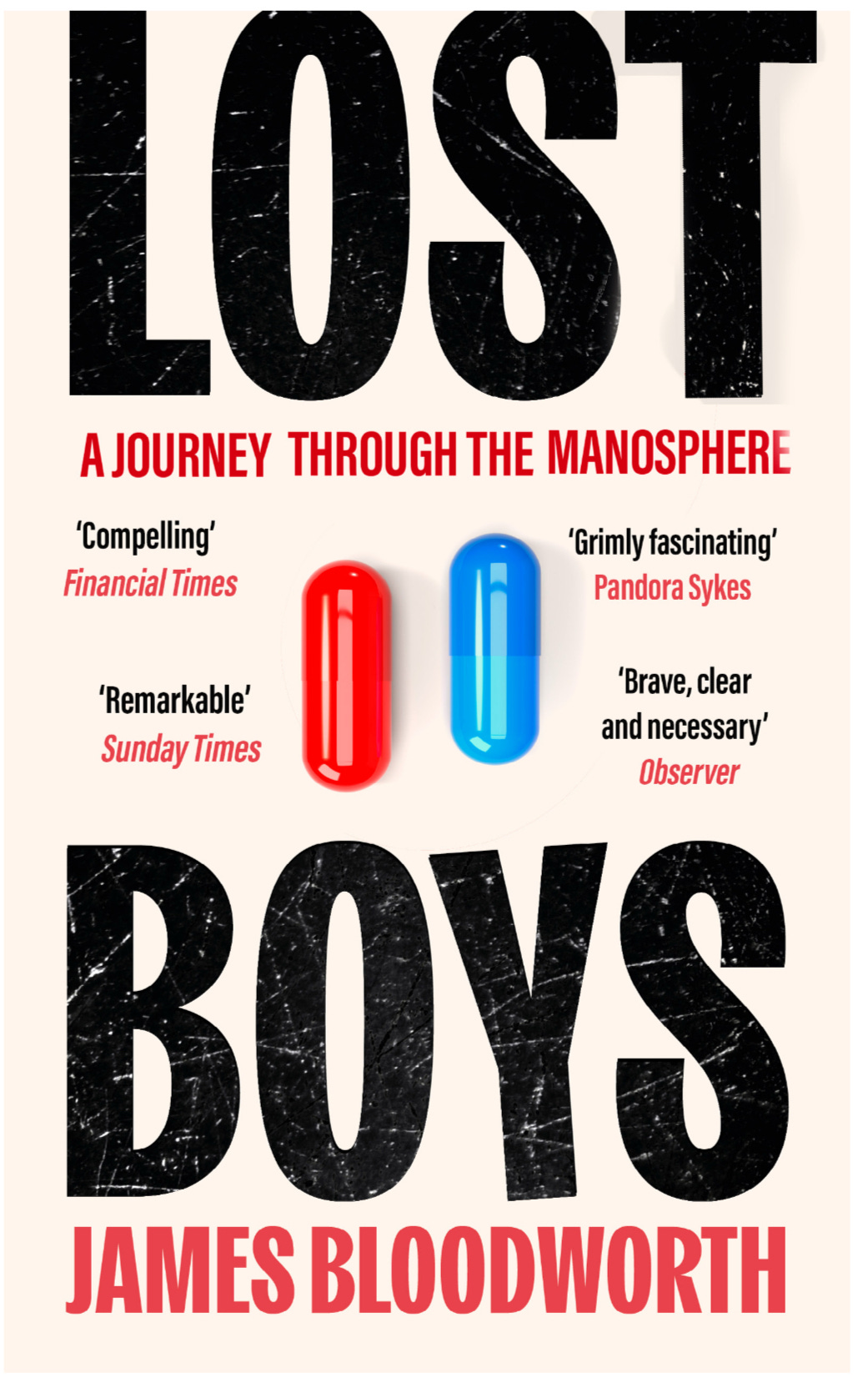
You can also buy my book Lost Boys, which is now out in paperback, here.
I don’t think any of this should be a shock. The trad right keeps weakening and will hopefully die the long-deserved death it has coming. At this point, all it can really do is scream at its receding audience about their supposed genetic and monetary inferiority, endlessly recycling the same buzzwords: “DEI” and “woke.”
I doubt Peterson completely falling apart will be the end of them, but I also don’t see them ever coming back with anywhere near the same force they once had. Conspiracy thinking was always inherent to their worldview, and the split over Israel can’t really be solved within the ideological world they constructed for their audience to live in.
Part of what makes a man like Tate so much more powerful is his openness about the fact that he is a liar. While Peterson drifts in and out of consciousness on various bullshit mechanical solutions, Tate openly laughs on stream about ripping off his own audience. Strangely, this only strengthens his message, because contradictions stop being contradictions and instead become proof of his worldview: lies designed to take money from fools.
The world of the “lobster” mindset has already made it clear that resenting this is itself a personal failure. In that worldview, there always needs to be a large class of losers so that a few can imagine themselves winners. In a way, it resembles how Nazi hatred of Jews in that world ultimately could not be due to religion, nationalism, race, or even conspiracy theories, it had to be due to German inferiority and humiliation projected outward.
There’s no real way out for these people. I’ve increasingly seen people on both the left and the right turn against men in general, so I frankly don’t see why turning to figures like Tate should surprise anyone. The alternative is often admitting your own worthlessness. And if Tate starts selling some bullshit medical treatment, his followers can simply dismiss it as another scheme to manipulate idiots into giving him money, they don’t even have to buy into it themselves.